Showing posts with label research. Show all posts

Friday, November 4, 2011

Sleeve Ruffles

On Mrs. P.'s recent journey to study all things 18th century, she spent many hours in many places looking at many things, but also chose to focus and ask to examine certain things.  One of which was sleeve ruffles.

Those necessary and yet so often overlooked accessories that can often make or break an entire impression.  I saw a large number and variety of ruffles.  Plain, laced, dresden work, simple and fancy whitework of all sorts and one pair that had a lovely array of eyelets worked around the edges!  Fabrics were muslin, linen, dimity and net, and yes, I said net.  (the net pair will probably be the first that I will try to reproduce).  Loved, Loved Loved!

Antique Textiles
This example from Antiques Textiles is very similar to those plain muslin ruffles that I examined.  The construction is as I have always thought and use today when I make sleeve ruffles, the fabric is gathered with whip gathers, and attached to the linen tape.  That was the universal way of attaching the fabric to the tape regardless of the style of the ruffle.  Not up for discussion, incontrovertible evidence of a sewing stitch not previously thought to be used in the 18th century.   Whip gathers allow the fabric to actually be hinged to the tape, which lets the fabric flair out and stand proud of the tape.  It is always nice to be validated, but it is more important is to find documented evidence of a useful technique.

Thursday, September 15, 2011

From Zero To Overload: Miss Kristin

or, how Miss Kristin can't contain her gown excitement.

I have suddenly been walloped by a big pink rubber mallet called Inspiration!

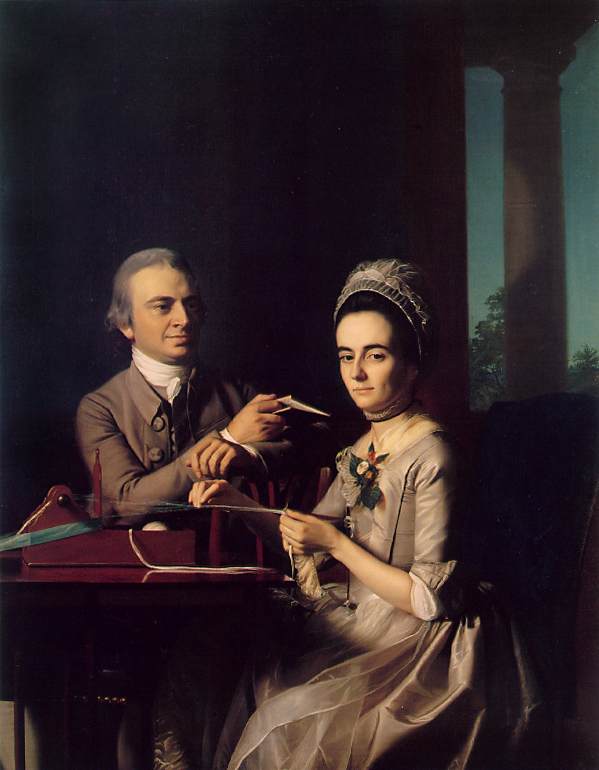
My dearest Mrs. Peabody, who has taken it upon herself to oversee myself and Miss Wendy's appropriate attire, has found several pieces of portraiture that have my head spinning and swimming in all things "Pretty Silk Gowns!" Adding the two Copley portraits I have been studying through correspondence with Miss Wendy, I feel as if I am on 18thc. overload! (Dear readers, this is not a bad thing!)

While I may be getting ahead of myself here, picking out a gown to reproduce before talking about basic elements, I think it relieves a large chunk of research, time, and maybe stress and anxiety, especially since it's already been "approved." Plus, having a point of inspiration already chosen leaves me time and energy to devote to other research--such as a shift, stays, stockings, on and on.

Here are the portraits I have been looking at, by Copley:


On the left, Mrs. Thomas Gage (Margaret Kemble), and on the left, Mr. and Mrs. Thomas Miffin (Sarah Morris). Click on the photos to be taken to their pages at the Timken Gallery of Art and the Philadelphia Museum of Art, respectively.

Teaching Moment! 

Miss Kristin has chosen a gown from a portrait that she likes without realizing that it is inventive costume used by the artist and is not a real gown.  This variation would be considered "Turkish", and was chosen to impart timelessness to the portrait, Copley was copying an artistic trend/fad in England.  As a newcomer, Miss Kristin doesn't  know about fantasy dress in portraits.  Mrs. Peabody

And, the two portraits Mrs. Peabody has picked out, one from the Connecticut Historical Society and the other from the Metropolitan Museum of Art:


Look these over, if you will my dear readers, and anticipate my next post: why these, and maybe, which one!

Tuesday, September 13, 2011

Mrs. Miles is Perusing Copley (In the nicest possible way)

Choosing my clothing

As I was perusing my copy of Copley (available used, at not too expensive prices, they go up and down, this book is a must-have for research!), I noticed some mistakes.   One does get used to this, eventually, but it continues to infuriate me!  On page 307, in the discussion of Mrs. Paul Richard, it says that she is wearing a plain cotton apron, and that Copley only painted women in aprons twice.   Well...that apron doesn't look like cotton to me, it looks like a not quite opaque linen, in other words, a very good every day apron, not one I'd wear to cook in!  They reference p. 314, Dorothy Quincy, in her apron, but then, on page 319 there is Mrs. Mifflin, in what is quite clearly an apron!


Dorothy Quincy in her apron (I much prefer to link to the owner of the painting, but MFA website is not cooperating.)


Mrs Mifflin in her apron


Since Mrs Skinner and Mrs Winthrop both have gowns with robings and ribbons in a typical pattern, I think I will make my new gown in their style, with ribbons on the stomacher, in a pink rather like Dorothy Quincy.

Thursday, September 8, 2011

The Love Letter

Miss Wendy again!
I have a few hunks of fabric that really want to be gowns, one a very pretty pinky peach love birds silk damask and the other a lavender silk taffeta. I’d planned the lavender to be a sacque, so I figured it was off limits to me for the Garden Party since we’re doing very serious, very specific research for this event (it’s not enough to say “well, it’s her mother’s old gown” in this case. We want to document everything...). I’ve been having trouble finding a damask I like to copy, though, original or portrait. Then I came across this:

This is a portrait by Jean-HonorĂ© Fragonard, “The Love Letter.” I haven’t found out who the girl in the painting is, I’m not sure that anyone knows, actually. The portrait is in the Metropolitan Museum of Art and is dated circa 1770, which is perfect for me! The girl is pretty young and that silk is gorgeous and depending on what image of the painting I look at I think it’s light green, light blue, grey, or even lavender, so my silk will work wonderfully!

Before I can even think about making this gown, though, I’m going to need to decide what I need under it. The only shifts I have are pretty coarse, not to mention the longer seams are machine done. I also have to figure out if I need pocket hoops or hip rolls for this.

Then there’s that cap. I think I want to copy the portrait exactly (Maybe I’ll pose for a photo recreating it! I don’t think that dog is a shih tzu like my family’s dog, but I could still use our dog for it!), so I need to work out that cap and hair. I don’t know anything about doing hair other than a plain bun, so that’ll take a lot of practice (and/or help!).

The great thing about this gown is that other than that cuff, I can’t see any of the trim. That means I get to trim it however I want! I’ll have to look at other silk gowns and get ideas. Plus, until I started thinking about this specific painting, it had never occurred to me to notice how much trim is on the sleeves versus the front of the gown. Can I have more on the front than the sleeves? Or does knowing that the cuffs are pretty simple mean the front should be too? So I’ll keep looking through books and start paying attention to trim ratios.

Now that I have a look to copy, my next step is to come up with everything I’ll need to recreate it and figure out what I have to get my hands on!

Monday, August 29, 2011

A Yellow Gown At The Met


On our recent journey to New York, Mrs S. and I were lucky to see this portrait in person in the American Wing in the Metropolitan Museum of Art.  Another good choice for young matrons and maidens as well to look to for their own reproductions!  Wearing a simple taffeta gown, this portrait of Margaret Strahan, was painted in 1771.  Her yellow silk gown closes in front with a compere stomacher.  Pinked self fabric trim twists and turns up the robings of her gown, simple but effective, providing a textural and 3 dimensional appearance so important to 18th century gowns.   This is not an expensive fabric, this gown can be reasonably reproduced by any re-enactor or costumer.


This closeup of the compere shows the small self fabric covered buttons that appear to be functional, not decorative and the two rows of pleated trim on either side of the buttons.  Neither difficult to do or expensive, no additonal purchase for trim.


Simple sleeve flounces and we can see the edges are pinked.  Two flounces and whitework sleeve ruffles set off the yellow of the gown and yet are simple in their embroidery design, something more easily duplicated than a complex embroidery design like Dresden work. 


This closeup of the pearl necklace shows us  six small pearl strands, with one giant strand of pearls, faux of course!  What a nice detail to incorporate into a necklace!   Faux pearls are a dime a dozen (literally) at rummage sales and yard sales, this would not cost a fortune to do.   If you look at the full portrait you can see the ribbon ties at the back of her neck securing the necklace.

 This last detail combines two elements.  First the gathered and pinked trim, gently flows up the robing.  Note that it does not match the pleated design on the compere, but the twisting on the robing is a nice balance to the geometric pleating on the compere.  This is also a good closeup of her neck thing.  It is obviously fine muslin or linen, with a series of box pleats providing the shaping as it goes around the neck.  It is not a handkerchief per se, but does the work of one, filling in the low neckline of the gown.  Could this be a tippet sighting?  Don't know! 

Please go to the museum site and look closely using the zoom feature.  Look especially at her hair ornaments, they almost look like enamel work to me.  Other opines welcome!

Mrs. Peabody

Friday, August 26, 2011

Your Underwear Is Showing!

Dearest Friends, 

When I was growing up, it was a social disgrace to let your bra straps show. I even sewed those little ribbons with the snaps into my sleeveless dresses to prevent that kind of fashion faux pas! Times change and fashion changes. And so it appears was the case in the 18th century with regards to shifts.
Detail from Smock Race by John Collet (Lewis Walpole Library)

Located next to your skin, and under your stays, by mere proximity alone, a shift is "underwear". so one would assume that this garment would only be seen hanging on the line after being laundered.  Not so - at least where the sleeve of the shift is concerned.  Underwear is worn as a fashion accessory!

Mrs Daniel Hubbard by Copley


In portraits, for a good part of the century, you frequently see a rather long shift sleeve sticking out below the outer gown sleeve, and often with an elaborate ruffle attached at the cuff of the shift. In the portrait at the left, you see an example from the 1760's showing a positively gorgeous ruffle and puffy shift sleeve displayed below the wide full cuff of her silk gown.  And there is no attempt to hide the lower part of the shift sleeve just above the ruffles.


Mrs. Ezekiel Goldthwait - Copley 1771


As the fashion changes from cuffs to tiers of sleeve ruffles and flounces, the now shorter shift sleeve is largely hidden making a super fancy shift sleeve ruffle superfluous. However, a peek of the shift sleeve does not morph into a "Glamour don't".  It's there and should the arm be in a position to show it, the wearer does not attempt to hide it.


 Thus is the case with my model Mrs. Skinner.

Mrs Skinner, shows off a diminutive shift ruffle, presumably of fine linen, attached to her shift cuff, which falls just beyond her elbow -- a detail to keep in mind when I measure for the length of the sleeves for my new shift. This is just the kind of detail we want to pay attention to when trying to assemble a really accurate look -- particularly connecting these details to time frame.   They seem, at first, incidental, but when put all together they truly help to create a much more accurate impression.

Mrs. Skinner's sleeve detail by Copley (1772)
Over the years I've become less hung up about the occasional bra strap offense, but I will gladly show off the lovely cuff and ruffle of my new shift's sleeves - but only when I bend my arm and my sleeve flounces fall away to expose it!  Underwear as a fashion statement - some things never change.

Yours truly,
Mrs. S.

Tuesday, August 16, 2011

Younger Set: Miss Wendy Till She Finds a Name

Wendy here--
I need a name, so I looked up Concord births from the early 1750s (I'll be 20 when we have our party, so I need a woman who was roughly 20 in 1773). I've narrowed it down to four names that I feel I wouldn't object to (I really didn't want to go by the name Hephzibah, for example...).
Now I'm deciding between Lydia Ball, daughter of Samuel and Percis Ball, born November 20, 1751, Rebekah Meriam, daughter of Josiah and Hannah Meriam, born September 12, 1751, Elisabeth Wheeler, daughter of Ezra and Rebekah Wheeler, born March 15, 1752, and Hannah Wesson, daughter of Stephen Wesson Junior and his wife Lydia, born June 2, 1752.
The next step is to look up the Balls, the Meriams, the Wheelers, and the Wessons. I want to know their economic statuses, where they lived, that kind of thing. Since I already have the fabric I want to use, I need one of them to be able to wear it.

The Younger Set: Miss Kristin

Hi, I'm a Sewing and Reenacting Newbie, taking part in this massive project to further my education and knowledge of the 18th century (specifically, the American Revolutionary War).

I'm not a blogging newbie, nor a newbie to history. I have my own 18th century blog chronicling my first gown, and I'm an emerging museum professional, nearly complete with the Tufts University Museum Studies certificate program. History museums are my thing, as is designing exhibits. I'm a graphic designer by trade, and that allows me to have one hand in the non-profit world, and the other in the for-profit world.

My focus for now is panned out to the max. I love material culture, so I plan on blogging about that, as well as showing the costuming, history, and blogging community what it's like to be a neophyte again (and maybe over your head just a wee bit). Expect posts on what a newbie may need, a reading list/library of books, inspiration posts, and just general discoveries. As we get closer to this part-ay, the focus will become smaller, and I hope to venture into a bit of primary source research for a persona. And, of course, the entire process of making a gown. Oh yes, the good stuff.

I hope to inspire other newbies to take the leap into handsewing, reenacting, and history. I plan on absorbing all the knowledge I can from the people I'm working with. And I am counting on you--yes, you!--to come along for the ride!

- S.R.N. (aka Miss Kristin)

Mrs. Miles an Introduction

Good Day! I am researching Mrs Ruth Barrett Miles, wife of Captain Charles Miles, both of Concord. I have portrayed Mrs Miles before, but I need more information about the family. I may, yet, change my mind about who I am.

I want a woman who married in the 1750s, and has 4-6 children, aged perhaps 6 (no younger!) to 20 or so, in the 1770s. I think being a mother with my oldest children in the their early twenties or late teens will match me the best! I expect her to have been born in the 1730s, of course, to make this work. I'm finding some, in addition to Ruth Miles, I really like Thankful Sarah Balcom, unless she is Sarah Thankful Balcom. I need to find a stronger source for her! But, I love her name!

I am making a list of potential women, with as much information about them as I can find online. Next week I will go to the special collections at the Concord Library. The next step after that may be the MA archives. We will see! I'm mainly looking for wealth information, to try to judge who might have a silk gown and who perhaps has a printed cotton, as their best.